
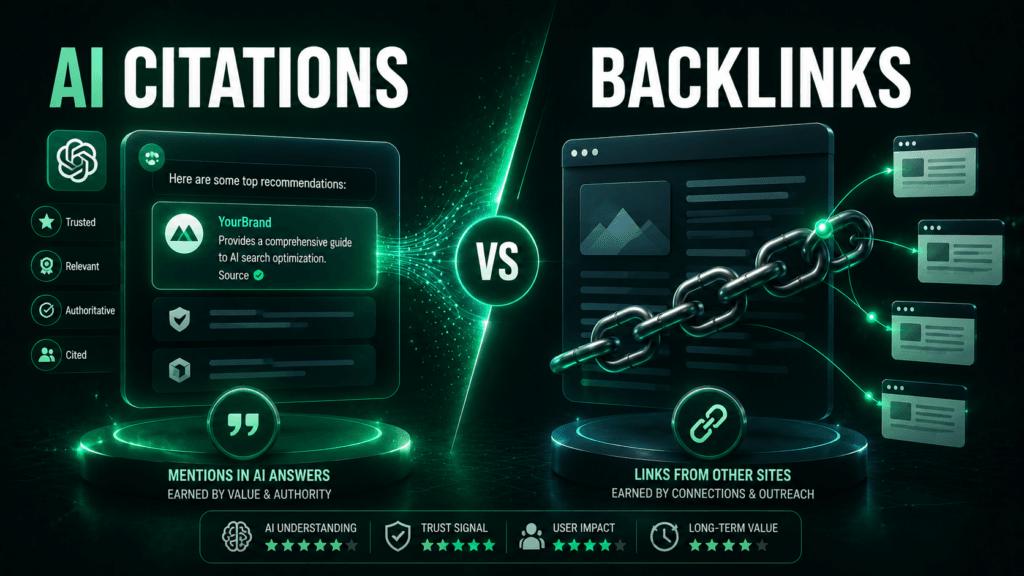
Backlinks still build authority. AI citations create visibility inside answer engines. Here is how brands should balance both in 2026.
Search visibility is no longer limited to ten blue links.
Today, people discover brands through Google AI Overviews, AI Mode, ChatGPT, Gemini, Perplexity, and other answer-driven search experiences. In these environments, users may see a brand mentioned, cited, or recommended before they ever visit a traditional search result.
That shift has created an important question for marketers: AI citations vs backlinks—which matters more in 2026?
The short answer is that backlinks still matter. They remain an important part of how search engines understand authority, relevance, and trust. But AI citations are becoming increasingly valuable because they determine whether your brand is visible inside AI-generated answers.
The smarter approach is not to choose one over the other. It is to understand what each signal does, where it matters, and how to build a strategy that supports both traditional SEO and Generative Engine Optimization (GEO).
What Are Backlinks?
A backlink is a link from another website to your website.
For years, backlinks have been one of the most important off-page SEO signals. When a credible website links to your content, it can help search engines understand that your page is useful, relevant, and worth considering for related searches.
Not all backlinks carry the same value. A relevant link from a respected industry publication is usually more meaningful than dozens of low-quality links from unrelated websites.
High-quality backlinks can help with:
- Organic rankings
- Referral traffic
- Brand authority
- Faster discovery of new pages
- Stronger topical relevance
- Trust signals across the web
For example, if a respected marketing publication links to your guide on Generative Engine Optimization, that link can help strengthen the perceived authority of both the article and your wider website.
Backlinks remain a core part of SEO because search engines use many signals to evaluate which pages are likely to be useful for a query. AI-powered search experiences are also built on traditional search foundations, which means technical SEO, useful content, and authority still matter.
What Are AI Citations?
AI citations are references, source links, or brand mentions that appear within an AI-generated response.
For example, when someone asks ChatGPT, Gemini, Perplexity, or Google AI Mode a question such as “What is Generative Engine Optimization?”, the system may generate an answer and reference websites that support its response.
Those references are AI citations.
Depending on the platform, an AI citation may appear as:
- A clickable source link
- A numbered reference
- An inline citation
- A source card
- A recommended website
- A brand mention without a direct link
- A list of suggested resources
AI citations are important because they can put your brand in front of users at the exact moment they are looking for an answer.
In many cases, the user may not perform a traditional Google search at all. They may ask an AI assistant directly, receive a shortlist of sources, and decide which brand to explore based on the answer.
AI Citations vs Backlinks: The Core Difference
The biggest difference is simple:
- Backlinks are signals pointing to your website from other websites.
- AI citations are visibility signals showing your website or brand inside AI-generated answers.
Backlinks are usually earned through digital PR, linkable assets, partnerships, expert contributions, original research, and high-quality content.
AI citations are earned when an AI system decides that your content, brand, or information is useful enough to support an answer.
| Factor | Backlinks | AI Citations |
|---|---|---|
| Main purpose | Build authority and referral value | Build visibility inside AI-generated answers |
| Where they appear | Other websites | ChatGPT, Gemini, Perplexity, Google AI features, and answer engines |
| Direct SEO impact | Can support rankings and authority | May support visibility and referral opportunities, but impact varies by platform |
| Control | You can actively pursue relevant links | You cannot directly control whether an AI system cites you |
| Measurement | Link tools, referral traffic, ranking changes | AI visibility tracking, referral data, manual prompt testing, and Search Console reports |
| Best use | Strengthening website authority | Increasing brand discovery in answer-led search |
Both matter, but they solve different problems.
Do AI Citations Replace Backlinks?
No. AI citations do not replace backlinks.
This is one of the biggest misconceptions around GEO and AEO.
A brand cannot ignore technical SEO, useful content, internal linking, authority building, and backlinks simply because AI search is growing. A page must still be crawlable, indexed, and eligible to appear in Google Search before it can be considered for AI features such as AI Overviews or AI Mode.
That means the basics still matter:
- Your pages need to be indexed.
- Your content needs to answer real user needs.
- Your site needs a clear structure.
- Your brand needs credibility.
- Your content needs to be better than generic, interchangeable information.
AI citations should be viewed as an additional outcome of strong SEO, not a shortcut around SEO.
Why AI Citations Matter More Than Before
Although backlinks remain important, AI citations are becoming more valuable because user behaviour is changing.
People increasingly use AI tools for:
- Researching products and services
- Comparing options
- Learning complex topics
- Asking follow-up questions
- Discovering brands
- Finding recommendations
- Summarising information
Google has also continued to develop AI Overviews and AI Mode as more conversational ways to search. To understand how these two experiences differ and what they mean for marketers, read our guide to Google AI Mode vs AI Overviews.
For a business, this changes the definition of visibility.
In the past, a brand might have focused on ranking in the top three organic results. Today, it may also need to ask:
- Does our brand appear when users ask AI tools for recommendations?
- Is our content cited when AI systems explain our topic?
- Are competitors being referenced more often than us?
- Are AI platforms sending referral traffic to our site?
- Does our brand have a clear and consistent entity presence across the web?
These questions are central to Generative Engine Optimization.
When Backlinks Matter More
Backlinks are usually more important when your goal is to strengthen long-term organic search performance.
They can be especially valuable for:
Competitive organic keywords
If you are trying to rank for a competitive keyword, high-quality relevant backlinks can help your content compete with established pages.
Building domain authority
A strong backlink profile can support the overall credibility of your domain, making it easier for new content to gain traction over time.
Referral traffic
A link from a trusted publication, newsletter, industry website, or community can send qualified visitors directly to your site.
Discoverability
Links help search engines and users discover your content. A well-linked content ecosystem also makes it easier for crawlers to find important pages.
Digital PR and brand trust
Earning links from respected publications can create benefits beyond rankings. It can improve brand awareness, establish expertise, and create third-party validation.
For ContentSpring, backlinks from credible marketing, SEO, SaaS, and business publications would help strengthen the site’s overall authority as it grows its GEO and AI Search content library.
When AI Citations Matter More
AI citations matter more when the user’s journey begins inside an answer engine rather than a traditional search results page.
They are especially valuable for:
Informational and research-led queries
Users often ask AI systems questions such as:
- What is GEO?
- How does AEO work?
- How do brands get recommended by ChatGPT?
- What is the difference between AI Overviews and AI Mode?
- How should marketers measure AI visibility?
For a deeper look at the signals that may influence AI recommendations, see our guide on how ChatGPT chooses which brands to recommend.
Brand recommendation queries
When users ask “Which agencies help with GEO?” or “What are the best tools for tracking AI visibility?”, appearing in the response can be more valuable than ranking for a broad informational keyword.
Complex comparisons
AI tools are increasingly used for comparisons, decision support, and multi-step research. A brand that is consistently cited in these conversations can become part of the buyer’s shortlist.
Zero-click environments
Some users will get their answer without clicking through. In those cases, a visible citation or brand mention may still create awareness even if it does not generate immediate traffic. This is one reason zero-click search is growing and why brands need to track visibility beyond website visits alone.
Emerging topic ownership
For newer categories such as GEO, AI Search Analytics, and Entity SEO, being cited early can help establish your brand as a recognised source before the space becomes more competitive.
How Backlinks Can Help You Earn More AI Citations
Backlinks and AI citations are not separate worlds.
A strong backlink profile can indirectly support AI visibility because links often reflect the same qualities that make content more likely to be useful in answer engines: relevance, credibility, originality, and third-party validation.
For example, a detailed guide may be more likely to earn both backlinks and AI citations if it includes:
- Original frameworks
- Clear definitions
- Expert perspectives
- Real examples
- Up-to-date research
- Useful comparisons
- First-hand experience
- Strong structure and headings
When other credible websites reference your content, it creates a broader web footprint around your brand. That can help search engines and AI systems better understand what your company is known for.
This is closely connected to Entity SEO. A brand that is consistently mentioned in relevant contexts across trusted websites is easier for systems to recognise as a credible entity in its category.
How to Build a Strategy for Both AI Citations and Backlinks
The best 2026 strategy is not “link building versus AI visibility.” It is building content and authority that work across both.
1. Publish content worth citing
AI systems are unlikely to benefit from generic content that repeats what hundreds of other articles already say.
Create pages that add something useful, such as:
- Original checklists
- Practical frameworks
- Templates
- Expert insights
- Data-backed findings
- Clear comparisons
- Real examples
- Updated explanations of fast-moving topics
For example, a generic article titled “What Is GEO?” may be useful. But a guide that explains GEO, compares it with SEO, includes an audit checklist, and shows how to measure visibility is more likely to become a reference point.
2. Build topical authority, not isolated articles
One strong article is helpful. A connected library is more powerful.
For ContentSpring, this means linking related articles together. Start with GEO vs SEO, then build supporting content around AI citations, brand mentions, Entity SEO, and AI Search Analytics.
This tells both users and search engines that your site covers the subject in depth.
3. Earn relevant, credible mentions
Do not chase random links or artificial mentions.
Instead, focus on earning visibility from places that are genuinely relevant to your audience:
- Marketing publications
- SEO communities
- Industry newsletters
- Podcasts
- Expert roundups
- Guest contributions
- Original research citations
- Partner websites
- Reputable directories where appropriate
The goal should be genuine recognition, not manufactured signals.
4. Make important information easy to find
AI systems and search engines need to understand what your page is about.
Use:
- Clear H1 and H2 headings
- Direct answers near the start of key sections
- Logical page structure
- Tables for comparisons
- Descriptive internal links
- Accurate titles and meta descriptions
- Relevant images and visuals where they add value
This does not mean writing robotic content or forcing every keyword variation into a page. It means making the information clear for people first.
5. Strengthen your brand entity
Make sure your brand information is consistent across your website and external profiles.
Your About page, author profiles, social profiles, business listings, and mentions should clearly communicate:
- Who you are
- What you do
- Who you help
- What topics you are known for
- Why your expertise is credible
A clearer brand entity can support both traditional SEO and AI visibility.
6. Track both outcomes
Backlinks can be tracked through SEO tools, referral data, and link reports.
AI citations require a broader approach. Track:
- AI referral traffic in GA4
- Brand mentions in AI answers
- Citations in Perplexity, Gemini, ChatGPT, and Google AI features
- Search Console impressions and pages
- Queries where your content gains visibility
- Competitor citations for key prompts
- Branded search growth
Use our guide on how to track AI search visibility KPIs to create a practical reporting framework from the start.
Common Mistakes to Avoid
Treating AI citations as a replacement for SEO
AI visibility does not remove the need for crawlability, indexing, quality content, internal links, and authority.
Buying low-quality backlinks
Cheap, irrelevant links can create risk without building meaningful authority.
Creating content only for AI systems
Write for people. Do not create content variations only to manipulate rankings or generative AI responses.
Chasing fake brand mentions
A mention only matters when it is genuine, relevant, and useful in context.
Measuring only clicks
AI visibility can create awareness before it creates referral traffic. Track impressions, citations, mentions, and branded demand alongside clicks.
AI Citations vs Backlinks: What Should You Prioritise in 2026?
If you are building a new website, start with the foundations:
- Publish genuinely useful content.
- Make sure it is crawlable and indexed.
- Build strong internal links.
- Create clear topical clusters.
- Earn relevant backlinks and brand mentions.
- Track whether AI systems begin to cite or recommend your brand.
If you already have a solid SEO foundation, invest more actively in AI visibility.
For most brands, the right balance is:
- Backlinks for long-term authority
- AI citations for answer-engine visibility
- Entity SEO for brand recognition
- GEO and AEO for content readiness
- Analytics for measuring the shift
The brands that win will not abandon SEO for AI search. They will use strong SEO to become more visible across every place people now ask questions.
Final Thoughts
The debate around AI citations vs backlinks is not really about choosing a winner.
Backlinks still help build authority, trust, and organic search performance. AI citations help brands become visible in the answers users receive from modern search and AI platforms.
In 2026, the most effective strategy is to build content that deserves both.
Create original, useful resources. Earn genuine recognition from credible websites. Strengthen your brand entity. Organise your content around the questions your audience is asking. Then measure how often your brand appears across search results, AI citations, and answer-driven experiences.
That is how SEO, GEO, and AEO work together.
Ready to Find Your AI Search Visibility Gaps?
Want to know whether your brand is visible in AI search, cited by answer engines, and prepared for the shift from rankings to recommendations?
Get a free AI Search Audit from ContentSpring. We will help you identify opportunities across SEO, GEO, AEO, Entity SEO, and AI visibility measurement.
Frequently Asked Questions
Are AI citations more important than backlinks?
AI citations are becoming more important for visibility in answer engines, but they do not replace backlinks. Backlinks still support authority, organic rankings, referral traffic, and long-term SEO performance.
Do AI citations improve Google rankings?
There is no confirmed rule that an AI citation directly improves Google rankings. However, the same qualities that can help content earn citations—usefulness, authority, originality, and relevance—can also support strong SEO performance.
How can I get cited by ChatGPT or Perplexity?
Create high-quality, original, well-structured content that directly answers important questions in your niche. Build topical authority, earn credible mentions, maintain accurate brand information, and publish resources that add value beyond generic summaries.
Do backlinks help with AI search visibility?
They can help indirectly. Relevant backlinks and credible third-party mentions can strengthen your authority and broader web presence, which may support the trust and recognition signals associated with AI visibility.
Should I stop link building and focus on GEO?
No. GEO should complement link building, technical SEO, content strategy, and Entity SEO. The goal is to build a brand that can rank in search results and appear in AI-generated answers.
What is the best way to measure AI citations?
Track AI referral traffic in GA4, manually test priority prompts across AI platforms, monitor brand mentions, review Search Console performance, and record which pages or brands are cited for key questions in your category.