
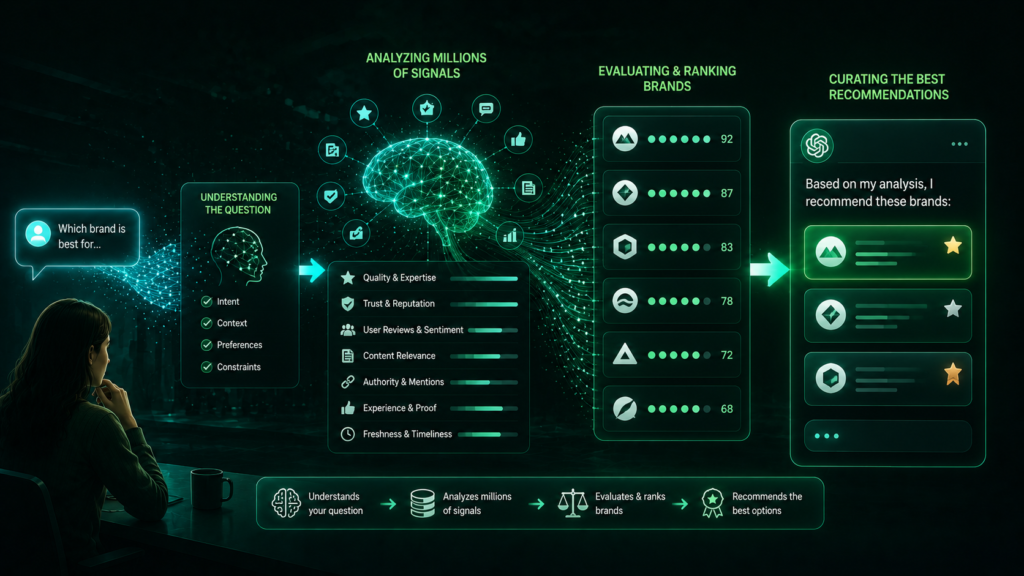
Ask ChatGPT “What’s the best project management tool for a small team?” and it won’t list ten options with links the way Google would. It’ll usually name two or three — confidently, by name, sometimes with a brief reason why. For brands, this raises an obvious and increasingly important question: how does ChatGPT decide which brands to recommend, and which ones it leaves out entirely?
Unlike traditional search rankings, there’s no public “ChatGPT ranking algorithm” to study, no leaderboard, no keyword tool that tells you exactly where you stand. But the pattern of how these recommendations form isn’t a mystery either — it follows from how large language models are trained, how they retrieve information, and what signals they treat as trustworthy. Understanding that pattern is the foundation of ChatGPT brand recommendations strategy and Generative Engine Optimization (GEO) more broadly.
ChatGPT Doesn’t “Rank” Brands the Way Google Does
It’s important to start with what ChatGPT is not doing. It isn’t running a real-time ranking algorithm against a live index of every brand in a category, the way Google ranks web pages for a query. Instead, recommendations come from a combination of:
- What the model learned during training — patterns about brands, their reputations, and how often (and how positively) they’re discussed across the text the model was trained on
- Real-time retrieval (when browsing/search is enabled) — pulling current information from the web to supplement or update what the model already “knows”
- Reasoning over both — the model synthesizes an answer that sounds confident and specific, based on the strongest, most consistent signals it has
This means a brand’s presence in ChatGPT’s recommendations is shaped by both its accumulated reputation and its current visibility on the web — not a single ranking factor.
The Signals That Influence Whether ChatGPT Recommends a Brand
1. Frequency and Consistency of Mentions
If a brand is mentioned repeatedly and consistently across many independent sources — review sites, comparison articles, forums like Reddit, news coverage, industry roundups — that repetition becomes a strong signal during training. A brand that shows up once on its own website looks very different, statistically, from one mentioned across dozens of independent third-party sources.
2. Context and Sentiment of Those Mentions
It’s not just how often a brand is mentioned, but how. Being consistently described as “reliable,” “the best option for X,” or “popular among small teams” builds a different association than being mentioned alongside complaints or as a cautionary example. Sentiment embedded in the surrounding text shapes how a model frames its recommendation.
3. Topical and Category Association
Brands that are clearly and repeatedly associated with a specific category or use case are more likely to be recalled when a user asks about that category. A brand that’s discussed broadly across many unrelated contexts has a weaker, fuzzier association than one consistently tied to a clear niche or use case.
4. Structured, Factual Clarity
Content that clearly states what a brand does, who it’s for, and how it compares to alternatives — in plain, well-structured language — is easier for a model to learn from accurately and easier to retrieve correctly when browsing is active. Vague, marketing-heavy language that avoids specifics gives the model less concrete information to work with.
5. Recency and Real-World Activity (When Browsing Is Active)
When ChatGPT uses live web retrieval, recent content matters. A brand with active, current content — recent reviews, updated comparison pages, fresh mentions — is more likely to surface accurately than one whose most visible information online is years out of date.
6. Authority of the Sources Mentioning the Brand
A brand mentioned in a well-regarded industry publication, an established review site, or a frequently cited comparison resource carries more weight than the same mention buried in a low-authority or spammy source. AI models, like search engines, implicitly weigh the credibility of where information comes from.
Why This Matters More Than Traditional Rankings for Some Queries
For many “best of,” “alternative to,” and recommendation-style queries, ChatGPT’s answer functions like a shortlist — often just two or three names. If your brand isn’t part of that shortlist, you’re not appearing on page two; you’re not appearing at all. There’s no scrolling further to find you. This makes the stakes of ChatGPT brand recommendations different from traditional SEO — see our GEO vs SEO playbook for how the two disciplines diverge — where even a page-two ranking still generates some visibility.
How to Improve Your Chances of Being Recommended by ChatGPT
Get Mentioned Consistently Across Independent, Credible Sources
Earning genuine coverage, reviews, and comparisons from third-party sites — not just your own website — is one of the strongest long-term levers. This includes industry publications, comparison sites, niche communities, and review platforms relevant to your category.
Make Your Positioning Unambiguous
Clearly state what your brand does, who it’s for, and what makes it different — in plain language, both on your own site and in any content you contribute elsewhere (guest posts, interviews, sponsored comparisons). Ambiguity makes you harder for a model to confidently recommend.
Build Genuine Topical Authority
Rather than trying to be associated with everything, focus your content and reputation-building around the specific category or use case you most want to be recommended for. A narrow, strong association beats a broad, weak one.
Keep Your Public Information Current
Outdated pricing, discontinued features, or stale comparison content can lead to inaccurate or unfavorable recommendations when AI systems retrieve live information. Regularly update comparison pages, review responses, and public-facing brand information.
Strengthen Entity Signals
Entity SEO — structured data, a consistent brand description across platforms, and clear entity relationships (your brand, your category, your competitors) — helps AI systems, and the search engines that often feed them, understand exactly what your brand is and where it fits.
Monitor What ChatGPT Currently Says About You
Periodically test relevant prompts in your category to see whether, and how, your brand is mentioned. This is the closest equivalent to “rank tracking” in a world without a public leaderboard — see our guide on tracking AI search visibility KPIs for how to set this up systematically.
The Bottom Line
ChatGPT doesn’t choose which brands to recommend through a single visible algorithm — it forms recommendations from accumulated reputation, consistent third-party validation, clear topical association, and (when browsing is active) current, well-structured information from across the web. Brands that earn genuine, consistent, credible mentions — and present their positioning clearly — are far more likely to be the names ChatGPT reaches for when someone asks for a recommendation.
At Content Spring, this is the core of what we help brands build: not just rankings on Google, but the kind of consistent, credible visibility that gets you recommended by ChatGPT, Gemini, and every AI system shaping how people discover and choose brands.
Get a Free AI Search Visibility Audit →
FAQs
How does ChatGPT decide which brands to recommend? ChatGPT forms brand recommendations based on patterns learned during training — including how frequently and positively a brand is mentioned across independent sources — combined with real-time web retrieval when browsing is enabled, rather than a single visible ranking algorithm.
Can you pay ChatGPT to recommend your brand? No. ChatGPT does not have a paid placement or advertising system for brand recommendations. Visibility comes from genuine third-party mentions, consistent reputation, and clear, accurate information about your brand across the web.
What’s the difference between SEO and optimizing for ChatGPT recommendations? Traditional SEO focuses on ranking web pages in search engine results. Optimizing for ChatGPT recommendations (a form of GEO) focuses on building consistent, credible third-party mentions and clear topical authority so AI models associate your brand confidently with relevant categories.
How can I check if ChatGPT recommends my brand? Periodically test prompts relevant to your category and use case directly in ChatGPT to see whether your brand is mentioned, how it’s described, and which competitors appear alongside or instead of you.