
Introduction
Google’s search experience is undergoing its biggest transformation since the introduction of featured snippets. With the rollout of AI Overviews and the emergence of AI Mode, search is shifting from a list of links to a conversation-driven experience.
For marketers, content teams, and SEO professionals, understanding the difference between these two AI-powered experiences is critical. As AI-powered search evolves, concepts like Generative Engine Optimization (GEO) become increasingly important for maintaining visibility.
While they may appear similar at first glance, they serve different purposes and have different implications for visibility, traffic, and content strategy.
In this guide, we’ll break down Google AI Mode vs AI Overviews, explain how each works, and explore what these changes mean for SEO, GEO, and AEO in 2026.
What Are Google AI Overviews?
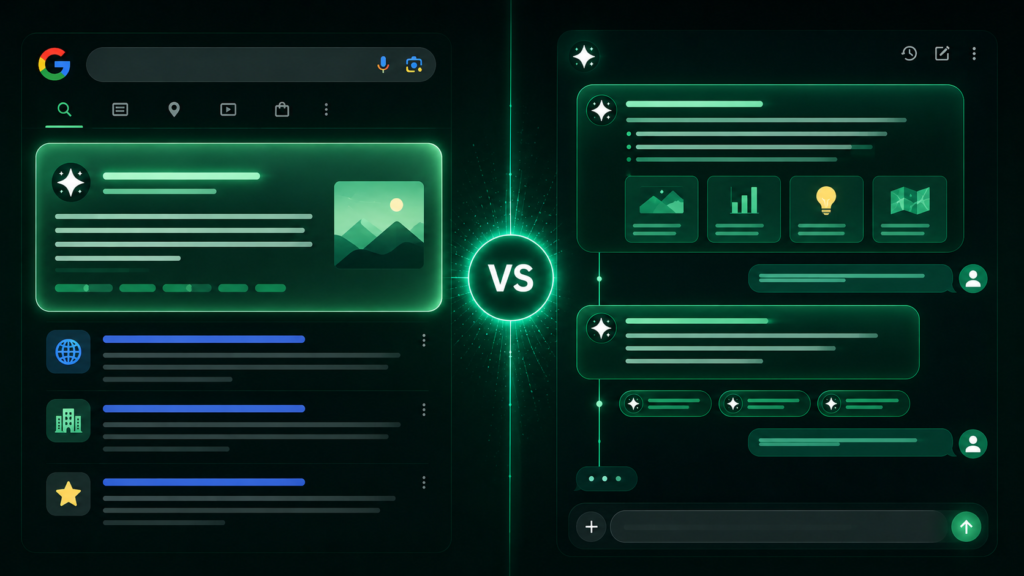
AI Overviews are AI-generated summaries that appear directly within traditional Google Search results. They are designed to provide quick answers to user queries by synthesizing information from multiple sources across the web.
Instead of clicking through several websites, users can often get the information they need directly from the overview.
Key Characteristics of AI Overviews
- Appear within the standard Google search experience
- Generated from multiple web sources
- Include source citations and links
- Primarily designed for informational queries
- Often appear above traditional organic listings
For example, a search for “How does Entity SEO work?” may trigger an AI-generated summary that explains the concept while citing several authoritative sources.
What Is Google AI Mode?
AI Mode takes Google’s AI experience a step further.
Instead of enhancing traditional search results, AI Mode creates a conversational interface where users can ask complex questions, follow up with additional prompts, and receive detailed AI-generated responses.
Think of AI Mode as Google’s answer to platforms like ChatGPT, Gemini, Claude, and Perplexity.
Users can:
- Ask multi-step questions
- Continue conversations
- Request comparisons
- Refine answers through follow-up prompts
- Explore topics in greater depth
Rather than returning a page of links, AI Mode acts more like an AI assistant.
Google AI Mode vs AI Overviews: Key Differences
| Feature | AI Overviews | AI Mode |
| Experience | Search Results Enhancement | Conversational AI Experience |
| User Interaction | Single Query | Multi-Turn Conversations |
| Goal | Quick Answers | Deep Exploration |
| Interface | Traditional Search | AI Chat Interface |
| Follow-Up Questions | Limited | Core Functionality |
| Competition | Organic Search Results | AI Assistants & Answer Engines |
The distinction is important because each experience changes how users discover information online.
What Does This Mean for SEO?
Traditional SEO is not disappearing.
However, the relationship between rankings, clicks, and visibility is changing.
For years, SEO success was measured by rankings and organic traffic. As AI-generated answers become more common, users may find answers without visiting websites.
This is creating a phenomenon many marketers call “The Great Decoupling”—where impressions increase while clicks decline.
In other words:
- Your content may be cited more often
- Your brand may gain visibility
- Organic traffic may not increase proportionally
Success is increasingly tied to visibility within AI-generated answers, not just rankings.
Why GEO Matters More Than Ever
Generative Engine Optimization (GEO) focuses on helping brands become trusted sources for AI-generated responses.
Whether a user interacts with Google AI Mode, ChatGPT, Gemini, or Perplexity, AI systems must decide which sources deserve to be referenced.
Brands that consistently demonstrate expertise, authority, and topical depth are more likely to be cited.
Key GEO strategies include:
- Building topical authority
- Strengthening entity recognition
- Publishing comprehensive content
- Earning high-quality mentions
- Creating clear and structured information
As AI-powered search expands, GEO becomes a critical complement to traditional SEO.
The Growing Importance of Entity SEO
Google’s AI systems increasingly rely on entities rather than keywords alone.
An entity can be:
- A brand
- A person
- A company
- A product
- A location
- An organization
When Google clearly understands your brand as an entity, it becomes easier for AI systems to recognize, reference, and recommend your content.
This is why Entity SEO is becoming a foundational strategy for AI visibility.
Brands that establish strong digital footprints across the web are better positioned to appear in AI-generated answers.
How Content Should Evolve
Content created solely to rank for keywords is becoming less effective.
Instead, brands should focus on:
Answer-First Content
Structure content around clear questions and direct answers.
Brands adopting an answer-first content structure are often better positioned to appear in AI-generated responses.
Comprehensive Topic Coverage
Cover topics deeply rather than publishing thin articles targeting individual keywords.
Structured Information
Use logical headings, lists, tables, and schema markup where appropriate.
Demonstrated Expertise
Show real-world knowledge, experience, and authority within your niche.
These practices improve both traditional SEO performance and AI visibility.
Will AI Mode Replace Traditional Search?
Not entirely.
Many searches still require users to visit websites, compare options, evaluate products, or complete transactions.
However, AI-generated answers are likely to become a larger part of the search experience.
The future of search will likely combine:
- Traditional search results
- AI Overviews
- Conversational AI experiences
- Voice search
- Answer engines
Brands that adapt early will have a competitive advantage.
Final Thoughts
Google AI Overviews and AI Mode represent two different stages of the evolution of search.
AI Overviews enhance traditional search by providing quick AI-generated summaries, while AI Mode transforms search into an interactive conversation.
For marketers and businesses, the shift is clear: visibility is no longer just about rankings.
Success increasingly depends on whether AI systems understand, trust, and reference your content.
Tracking these mentions and citations requires a dedicated AI search visibility strategy.
That’s why modern search strategies should combine traditional SEO with GEO, AEO, and Entity SEO to ensure your brand remains visible in the age of AI-powered search.
Frequently Asked Questions
What is the difference between AI Mode and AI Overviews?
AI Overviews provide AI-generated summaries within traditional search results, while AI Mode offers a conversational AI experience that allows users to ask follow-up questions and explore topics in depth.
Does AI Mode affect SEO?
Yes. AI Mode changes how users discover information and increases the importance of AI visibility, brand authority, and Generative Engine Optimization (GEO).
Are AI Overviews replacing organic search results?
No. Organic search results still appear, but AI Overviews often occupy prominent positions and may reduce clicks for some informational searches.
How can brands improve visibility in AI search?
Brands can improve AI visibility by building topical authority, strengthening Entity SEO, publishing comprehensive content, and implementing GEO best practices.