
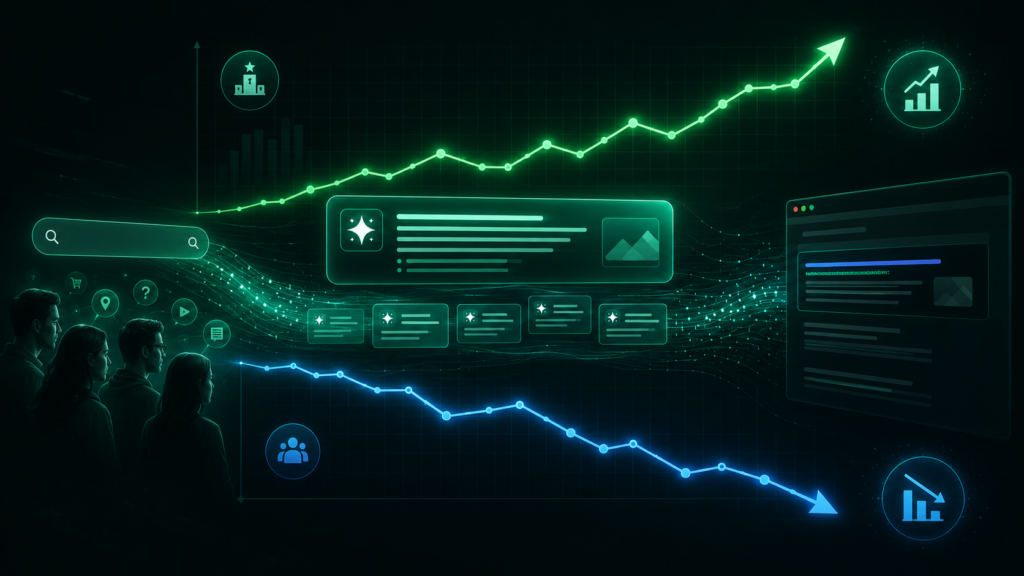
If you’ve checked Google Search Console recently and felt confused, you’re not alone. Your average position is improving. You’re ranking #2, #3, sometimes even #1 for keywords you’ve worked hard to target. And yet, your organic traffic is flat ,or worse, falling.
This isn’t a tracking error. It isn’t a Google penalty. It’s a structural shift in how search works, and at Content Spring, we call it the Great Decoupling: the breaking of the long-assumed link between ranking well and getting clicked.
For over two decades, SEO operated on a simple promise: rank higher, get more traffic. That promise is no longer guaranteed. Understanding why ,and what to do about it ,is now essential for every marketing team, founder, and SEO professional.
What Is the Great Decoupling in SEO?
The Great Decoupling describes the growing gap between search rankings and search traffic. A page can hold a strong position in Google’s results and still receive fewer clicks than it did a year ago, because the result itself is no longer the destination ,it’s becoming the source material for an AI-generated answer that sits above it.
In short: you can win the ranking and still lose the click.
This is the direct result of AI Overviews, Google’s AI Mode, and the rise of zero-click search experiences, where Google (and other AI search engines) answer the user’s query directly on the results page using content pulled from top-ranking sites ,without the user ever needing to visit them.
Why Rankings No Longer Guarantee Traffic
1. AI Overviews Sit Above Traditional Results
When Google generates an AI Overview, it typically synthesizes information from several top-ranking pages into a single answer block at the top of the SERP. Your page might be one of the sources cited ,but the user’s question is already answered before they scroll down to your listing.
The result: your ranking position is technically excellent, but your click-through rate (CTR) for that query can drop significantly, sometimes by 30-50% or more, depending on the query type.
2. Informational Queries Are Hit Hardest
Not all search traffic is affected equally. Queries with clear, factual, easily-summarized answers ,”what is,” “how to,” “best ways to,” definitions, comparisons, statistics ,are exactly the type of queries AI Overviews handle well. These are often top-of-funnel (TOFU) queries that brands have spent years optimizing for.
Transactional and highly specific long-tail queries are less affected, because AI systems are more cautious about generating answers involving pricing, availability, local information, or decisions with real-world consequences.
3. Your Content Is Being Used ,Just Not Visited
This is the part that frustrates SEO professionals the most. Your content quality, structure, and authority are still working. Google (or ChatGPT, or Perplexity, or Gemini) is reading your page, deciding it’s a trustworthy source, and using it to construct an answer. You’re contributing to the ecosystem ,you’re just not capturing the visit.
This is why rankings and impressions can hold steady or even increase, while clicks decline. Your content has shifted from being a destination to being an input.
How to Confirm You’re Experiencing the Great Decoupling
Before assuming this is what’s happening to your site, verify it in your data. Here’s how:
- Open Google Search Console and compare Impressions vs. Clicks over the last 6-12 months for your top informational pages.
- Look for a widening gap: if impressions are flat or growing but clicks are declining, and average position is stable or improving, that’s the signature pattern.
- Check CTR by query, not just by page. Queries that now trigger AI Overviews often show a sharp CTR drop compared to queries that don’t.
- Cross-reference with GA4: confirm the drop is in organic sessions, not a tracking or attribution issue.
If your data shows strong rankings, stable or rising impressions, and falling clicks ,congratulations (sort of). You’ve confirmed the Great Decoupling is affecting your site.
What This Means for Your SEO Strategy
The instinct for many SEO teams is panic: “Our SEO is broken, let’s redo our keyword strategy.” But that’s the wrong read. Your SEO isn’t failing ,the destination for that traffic is changing.
Here’s the strategic shift that matters:
Traffic Is No Longer the Only Success Metric
If your brand is being cited in AI Overviews and AI chat responses, you’re gaining something valuable: visibility and trust at the exact moment someone is researching a decision ,even if they don’t click through immediately. This is brand-building happening inside the search experience itself.
GEO and AEO Become Non-Negotiable
Generative Engine Optimization (GEO) and Answer Engine Optimization (AEO) are no longer “nice to have” additions to SEO ,they’re how you ensure your brand is the one being cited, recommended, and trusted by AI systems, even when the click doesn’t happen.
This means optimizing for:
- Clear, extractable answers near the top of your content
- Strong entity signals (so AI systems know who you are and what you’re an authority on)
- Structured data that helps AI systems parse and trust your content
- Content that AI models want to cite because it’s accurate, well-sourced, and well-organized
Rethink Which Pages Need Traffic vs. Visibility
Not every page needs to “win the click.” Top-of-funnel, informational content can do its job by getting your brand cited and recognized by AI systems ,building familiarity that pays off later in the funnel. Meanwhile, bottom-of-funnel, commercial, and transactional pages ,where AI systems are more conservative about generating direct answers ,remain your primary traffic and conversion drivers.
How Brands Should Respond to the Great Decoupling
- Audit your funnel-stage content mix. Identify which pages are informational (likely to be “decoupled”) versus commercial (likely to retain clicks).
- Double down on entity and brand-building signals, not just keyword rankings. Entity-first SEO increases your odds of being the brand AI systems recommend.
- Track AI referral traffic separately in GA4 and Search Console ,ChatGPT, Perplexity, and Gemini referrals are a growing (if still small) traffic source worth monitoring.
- Optimize bottom-of-funnel pages aggressively ,this is where clicks still convert to revenue, and where AI systems are least likely to fully replace the need for a visit.
- Treat AI citations as a new KPI. Being mentioned by name in an AI Overview or chatbot response, even without a click, is measurable brand equity.
The Bottom Line
The Great Decoupling isn’t a sign that SEO is dying ,it’s a sign that the definition of SEO success is expanding. Rankings still matter. But in 2026 and beyond, the brands that win aren’t just the ones ranking #1 ,they’re the ones being cited, recommended, and trusted across Google, AI Overviews, ChatGPT, Gemini, and every AI system shaping how people discover brands.
At Content Spring, this is exactly the shift we help brands navigate ,building SEO and GEO strategies designed not just to rank, but to make your brand the answer AI systems choose to give. If your rankings are climbing but your traffic isn’t following, it might be time to look beyond traditional SEO metrics.
Get a Free AI Search Visibility Audit →
Related Reading
- GEO vs SEO: The 2026 Playbook for AI Search Citations
- Answer Engine Optimization Strategy
- How to Track AI Search Visibility KPIs in 2026
- Google AI Mode vs AI Overviews
FAQs
Why is my SEO traffic dropping while my rankings are improving?
This is often caused by AI Overviews and AI Mode answering user queries directly on the search results page, reducing the need to click through ,even when your page ranks highly and is used as a source.
Is the Great Decoupling the same as a Google penalty?
No. A penalty causes both rankings and traffic to drop. The Great Decoupling specifically describes rankings holding steady or improving while clicks decline, due to AI-generated answers absorbing the click.
How can I tell if AI Overviews are affecting my traffic?
Compare impressions and clicks in Google Search Console over time. If impressions are stable or growing, average position is stable or improving, but clicks are declining ,especially for informational queries ,AI Overviews are likely a factor.
Should I stop targeting informational keywords?
No. Informational content still builds topical authority and entity recognition, which influences whether AI systems cite and recommend your brand. The goal shifts from “win the click” to “win the citation.”