
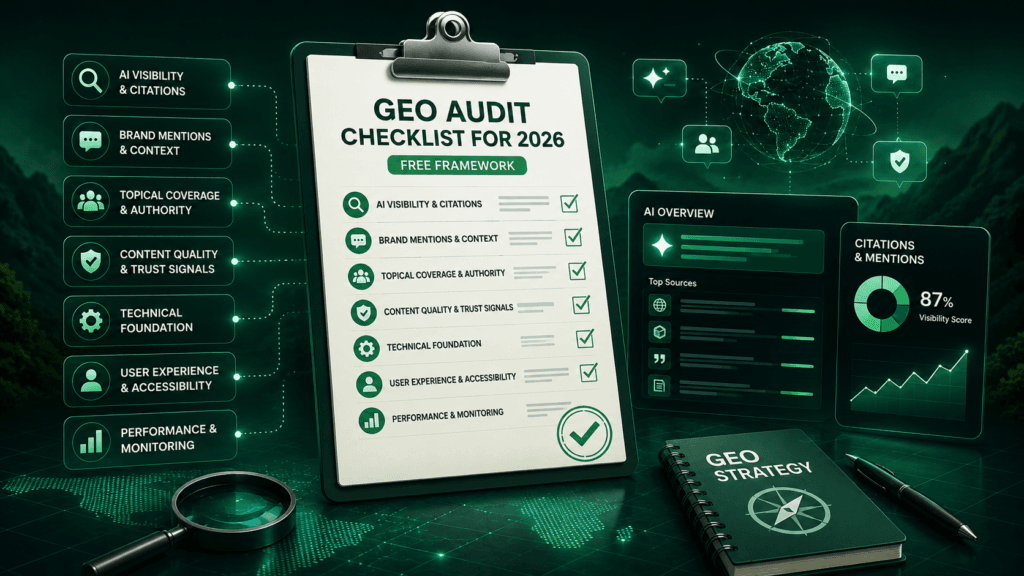
Most “GEO audit” content circulating right now is built on tactics that don’t actually hold up. In May 2026, Google published its first official guidance on optimizing for generative AI search features and it directly contradicted a lot of what’s been sold as “AI SEO” over the past year. Google’s guidance is clear: site owners can ignore tactics like content chunking, creating special AI text files such as llms.txt, or pursuing inauthentic mentions, and instead should keep building on the same SEO foundations that have always mattered.
That’s good news, actually. It means a proper GEO audit checklist isn’t a list of exotic new hacks it’s a structured way of confirming your foundational SEO and entity signals are strong enough to be picked up, trusted, and cited by AI systems like Google’s AI Overviews, AI Mode, ChatGPT, Gemini, and Perplexity. This checklist walks through exactly what to check, in order, and why each section matters.
Why a GEO Audit Is Different From a Traditional SEO Audit (And Why It Isn’t)
A GEO audit overlaps heavily with a technical SEO audit crawlability, indexing, and content quality still form the base layer. Google’s guidance confirms that AI Overviews and AI Mode run on the same ranking and retrieval systems as traditional Search, rather than a separate AI-only index. That means if your content isn’t technically sound enough to rank in regular search, it has no path into AI-generated answers either.
Where a GEO audit adds new dimensions is in checking signals that matter specifically for how AI systems select, synthesize, and cite sources entity clarity, topic comprehensiveness, demonstrated first-hand expertise, and visibility across AI platforms beyond Google. See our GEO vs SEO playbook for a deeper breakdown of where the two disciplines diverge. The eight sections below cover both layers.
1. Crawlability and Indexing
Before anything else, confirm AI systems can actually access and understand your content. This is the non-negotiable foundation.
Check:
- Are your priority pages indexed in Google Search Console? (Check the Pages report under Indexing)
- Does robots.txt block any pages or resources that should be crawlable?
- Are there any “noindex” tags accidentally left on important pages?
- Is your XML sitemap submitted and up to date?
- Do your pages load cleanly without JavaScript-dependent content that crawlers might miss?
Why it matters: AI Overviews are grounded in Google’s normal search index, and the links shown under an Overview are real ranking results if a page isn’t indexed and eligible to appear in regular Search, it cannot appear in AI features. No amount of “AI optimization” compensates for a page Google can’t crawl or has chosen not to index.
2. Entity Consistency
Entity SEO means AI systems need to clearly understand who your brand is, what it does, and how it relates to other entities (competitors, categories, locations) before they’ll confidently cite you.
Check:
- Is your brand name, description, and core offering consistent across your website, Google Business Profile, LinkedIn, and other directories?
- Does your site have an Organization schema markup with accurate sameAs links to your verified social profiles?
- Are your founder/author names consistent and linked to real, verifiable profiles (LinkedIn, author bio pages)?
- Does your “About” page clearly and unambiguously state what you do and who you serve?
Why it matters: Fragmented or inconsistent entity signals make it harder for AI systems to confidently associate your brand with a topic or category weak entity clarity is one of the most common reasons a credible brand still gets left out of AI-generated answers.
3. Topic Coverage
AI systems favor sources that comprehensively cover a topic over those that address only a narrow slice of it.
Check:
- For your core topics, do you have content addressing the full range of related sub-questions a user might ask not just the primary keyword?
- Are there obvious gaps in your content clusters where competitors are more comprehensive?
- Do your pages internally link to related content, signaling topical depth to both users and crawlers?
- Is your content organized into clear clusters (pillar pages + supporting articles) rather than scattered, disconnected posts?
Why it matters: A site that thoroughly covers a topic from multiple angles is more likely to be treated as an authoritative source AI systems can pull from confidently, rather than a partial answer that needs supplementing elsewhere.
4. First-Hand Expertise
This is arguably the single most important and most overlooked factor in Google’s current guidance.
Check:
- Does your content include original insight, data, examples, or experience not just a restatement of what’s already published elsewhere?
- Are your articles attributed to a real author with demonstrable expertise in the topic?
- Would a reader learn something they couldn’t get from five other generic articles on the same topic?
Why it matters: Google’s guidance explicitly emphasizes creating non-commodity content that’s helpful, reliable, and people-first focused on unique, expert-led content that provides value beyond common knowledge. Generic, AI-written content that simply repackages existing information is precisely what this guidance is steering away from.
5. Structured Data
Structured data still has a role just not the role most “AI SEO” content claims it does.
Check:
- Do your key pages have appropriate schema markup (Article, Organization, FAQ, Product, etc.) implemented correctly?
- Is your schema free of errors (check via Google’s Rich Results Test)?
- Have you avoided over-investing in speculative “AI-specific” schema types not recognized by major search engines?
Why it matters: Google has clarified there’s no special schema.org structured data required specifically to appear in AI Overviews structured data stays useful for rich results, but it’s not an “AI Overview door opener” on its own. Implement it for what it’s actually good for (rich results, clarity for crawlers), not as a silver bullet for AI visibility.
6. Brand Mentions
How often, and how credibly, your brand is mentioned across the web outside your own domain.
Check:
- Search your brand name to see what third-party mentions exist review sites, comparison articles, industry roundups, forums like Reddit
- Are existing mentions accurate and current, or outdated/incorrect?
- Are you earning mentions organically through genuine coverage, or relying on manufactured/low-quality placements?
Why it matters: Google’s guide explicitly lists pursuing inauthentic mentions as a tactic to ignore. Genuine, consistent third-party validation is a meaningfully different (and more durable) signal than artificially manufactured brand mentions, and it’s one AI systems weigh when forming recommendations.
7. AI-Platform Visibility Checks
Beyond Google, check how your brand currently shows up across the AI tools your audience may already be using.
Check:
- Test relevant prompts in ChatGPT, Gemini, and Perplexity related to your category and offerings
- Note whether your brand is mentioned, how it’s described, and which competitors appear instead
- Spot-check whether Google’s AI Overviews cite your pages for queries you rank for in traditional search
Why it matters: This is your closest equivalent to manual “rank tracking” in a world without a public AI visibility leaderboard see our breakdown of how ChatGPT chooses which brands to recommend for the specific signals worth checking. It tells you concretely where the gaps are, rather than guessing.
8. Measurement Setup
A GEO audit isn’t a one-time exercise it needs ongoing measurement to track whether your visibility is improving.
Check:
- Is Google Search Console properly configured to monitor impressions vs. clicks by query?
- Are you tracking AI-referral traffic separately in GA4 (ChatGPT, Perplexity, and similar sources are increasingly visible as referral traffic)?
- Do you have a recurring process (monthly or quarterly) for re-testing AI prompts and re-checking citations? Our guide on tracking AI search visibility KPIs walks through a practical setup.
Why it matters: Without consistent measurement, it’s impossible to know whether your GEO efforts are actually moving the needle, or whether shifts in visibility are coming from something else entirely.
What This Checklist Deliberately Leaves Out
If you’ve read other “GEO checklists,” you may notice some popular items missing here and that’s intentional. Google’s guide explicitly states that site owners do not need llms.txt files, content chunking, special schema, or AI-specific rewriting to appear in AI Overviews or AI Mode. These tactics get sold heavily because they sound technical and new, but what people call AEO or GEO is, in Google’s own framing, foundational SEO executed well strong content with unique expertise, clean technical structure, and optimized signals, not a separate game requiring separate tactics.
How to Use This Checklist
Work through the eight sections in order crawlability and entity consistency first, since AI-platform visibility checks and measurement are meaningless if the foundation underneath them is broken. For most sites, the audit surfaces a handful of fixable gaps rather than requiring a full rebuild: a missing schema field here, an inconsistent brand description there, a content cluster with an obvious hole in coverage.
The Bottom Line
A real GEO audit isn’t about chasing speculative AI hacks it’s a disciplined check of the same foundations that have always driven search visibility, applied with an eye toward how AI systems specifically select and cite sources. Brands that get this right aren’t doing something exotic; they’re doing SEO well, with entity clarity, genuine expertise, and consistent measurement layered on top.
If you’ve never run a structured audit against all eight of these areas, there’s a good chance there are gaps costing you visibility right now in Google’s traditional results, in AI Overviews, and across ChatGPT, Gemini, and Perplexity.
At Content Spring, this exact checklist is the starting point for every GEO engagement we run. We audit against all eight areas, identify the highest-impact gaps, and build a prioritized plan to close them.
FAQs
What is a GEO audit?
A GEO audit is a structured review of a website’s technical SEO foundations, entity signals, content quality, and AI-platform visibility to identify gaps preventing it from being cited or recommended by AI search systems like Google AI Overviews, ChatGPT, and Gemini.
Is GEO different from SEO?
According to Google’s official 2026 guidance, GEO and AEO are not separate disciplines from SEO they are foundational SEO best practices (technical structure, content quality, expertise) applied with attention to how AI systems specifically select and cite sources.
Do I need an llms.txt file for AI search visibility?
No. Google’s official guidance states that llms.txt files are not required and are treated like any other text file by its crawlers they are not a ranking or visibility factor for AI Overviews or AI Mode.
Does structured data help with AI Overviews?
Structured data remains useful for earning rich results in traditional search, but Google has clarified there is no special schema markup required specifically to appear in AI Overviews or AI Mode.
How often should I run a GEO audit?
A full GEO audit is worth running quarterly, with lighter monthly checks on AI-platform visibility (testing prompts in ChatGPT, Gemini, and Perplexity) and measurement metrics like impressions-to-click ratios in Search Console.