
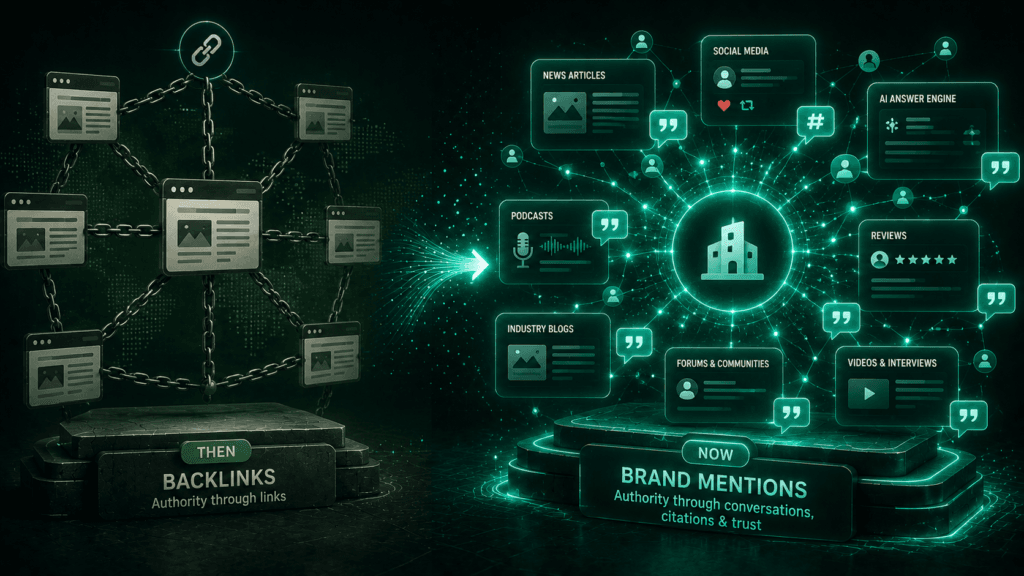
For two decades, backlinks were the single most important off-page signal in SEO. The logic was simple: a link from another site to yours was a vote of trust, and the more votes you accumulated from credible sources, the higher you ranked. That logic still holds in traditional search — but a significant shift is underway in how AI systems evaluate brand authority, and the data behind it is worth paying attention to.
In August 2025, Ahrefs studied 75,000 brands to determine which signals most strongly correlate with AI search visibility across Google AI Overviews, ChatGPT, and AI Mode. The findings reordered the conventional SEO playbook: unlinked brand mentions correlated with AI visibility at 0.664 — more than three times stronger than total backlinks at 0.218. A December 2025 follow-up extended the study to more AI platforms and reached the same conclusion.
This doesn’t mean backlinks are dead. But it does mean that for brands building visibility in an AI-driven search landscape, the marginal investment in earned mentions — appearing consistently and credibly across third-party sources — is now measurably more valuable for AI citation than accumulating more links.
What’s Driving the Shift
AI Systems Learn From the Whole Web, Not Just the Link Graph
Traditional search engines were built on the link graph — a map of which pages link to which other pages, used to infer authority and relevance. AI systems are trained differently. They learn from vast amounts of text across the web, which means they absorb not just where links point, but what the web says about brands, products, and entities in context.
When a brand is mentioned repeatedly across independent, credible sources — editorial coverage, comparison articles, industry roundups, user reviews, community discussions — the AI model develops a strong association between that brand and a specific category or capability. That association is what gets a brand cited in an AI-generated answer, and it’s built from mentions, not just links.
Entity Recognition Matters More Than Link Equity
In entity-first SEO, the goal is for AI systems to clearly and confidently understand what your brand is, what it does, and why it’s credible — independently of whether someone has followed a link to your site. A backlink says “this page is worth navigating to.” A brand mention in credible context says “this brand is worth trusting.” In the AI citation paradigm, trust outweighs navigation.
Nofollow Links and Unlinked Mentions Both Count
One of the most practically significant findings from the Ahrefs study: nofollow links carry nearly the same AI visibility signal as dofollow links, and unlinked brand mentions — where a publication mentions your brand name without a hyperlink — still contribute meaningfully to how AI systems form brand associations. This breaks from two decades of SEO orthodoxy, where nofollow links and unlinked mentions were often treated as second-tier signals not worth pursuing.
For brands, this means coverage that SEOs would previously have dismissed as “low value” (a mention in a newsletter, a reference in a forum thread, a brand name in a YouTube transcript) now contributes to the entity authority that drives AI recommendations.
What This Means in Practice
Digital PR Is Now a Direct AI Visibility Strategy
Earning genuine editorial coverage — being mentioned in “best of” roundups, comparison guides, industry publications, and analyst reports — has always been valuable for brand building. It’s now also a measurable driver of AI search visibility. Digital PR isn’t a soft brand exercise anymore; it’s how you build the mention density that gets you cited by ChatGPT, Gemini, and Google’s AI Overviews.
Muck Rack’s analysis of over one million AI-cited links found that 82% come from earned media. That figure makes digital PR the single highest-leverage activity for AI citation, ahead of technical optimization and traditional link building.
Backlinks Still Matter — But the Logic Has Changed
Backlinks remain important, and the Ahrefs data still shows a positive correlation between domain authority and AI visibility — but it’s a threshold effect, not a linear one. Sites need to reach a baseline level of link authority before AI systems seriously consider them as credible sources. Below that threshold, more links help. Above it, additional links matter much less than mention density.
The implication: for brands that have already built reasonable domain authority, the next marginal investment should go toward mentions — community presence, review generation, industry coverage, and third-party comparisons — rather than yet another link placement.
Content Volume Doesn’t Drive AI Citation
The Ahrefs December 2025 study found almost no relationship between the number of pages on a site and AI visibility. Brands publishing high volumes of content hoping to increase citation frequency aren’t moving the right lever. What moves AI citation is being discussed consistently across credible external sources — not having more pages on your own site.
This directly supports Content Spring’s approach of treating content quality and brand authority as the foundation — not content volume.
The Practical Implication for Your Strategy
1. Audit your current mention footprint. Search your brand name in Google, ChatGPT, and Perplexity to see where you currently appear and how you’re described. If most mentions are on your own site, that’s the gap to close.
2. Prioritize earned media over link volume. Focus on getting your brand genuinely mentioned in third-party content relevant to your category — industry publications, niche newsletters, comparison guides, review platforms, and community forums your audience uses.
3. Don’t ignore nofollow and unlinked mentions. A mention in a high-authority publication that uses a nofollow link or no link at all still contributes to your entity authority in AI systems. Don’t filter these out of your PR strategy.
4. Treat consistency as a signal. A brand mentioned once in one place doesn’t build strong AI association. Consistent mentions across multiple independent sources in the same topical context is what creates the reliable brand-category association AI systems draw from when forming recommendations.
5. Track AI citation separately from traditional rankings. Monitor your AI search visibility by testing relevant prompts in ChatGPT, Gemini, and Perplexity regularly — this is your brand mention equivalent of rank tracking in a world where there’s no public AI leaderboard.
The Bottom Line
Backlinks built the authority architecture of the early web. Brand mentions are building the trust architecture that AI systems use to decide what to recommend. The Ahrefs data is the clearest signal yet that the off-page SEO playbook is being rewritten — not because links stopped working, but because AI systems weigh a different set of signals when deciding which brands to cite and recommend.
The brands winning in AI search aren’t the ones with the most links. They’re the ones being talked about in the most credible places, in the most relevant contexts, most consistently.
At Content Spring, we help brands build the kind of distributed, credible presence that gets you cited — not just ranked. If you’re not sure where your brand currently stands in AI search, a GEO audit is the right place to start.
Frequently Asked Questions
Are brand mentions more important than backlinks for SEO in 2026?
For traditional search rankings, backlinks remain a top-three ranking factor. For AI search visibility, Ahrefs’ study of 75,000 brands found unlinked brand mentions correlate with AI citation at 0.664 — more than three times stronger than total backlinks at 0.218. Both matter, but the balance has shifted.
Do unlinked brand mentions help with SEO?
Yes, particularly for AI search visibility. Unlinked brand mentions contribute to entity authority — how clearly and confidently AI systems associate your brand with a topic or category — even without passing traditional link equity. Nofollow links from high-authority sources carry a similar signal.
How do brand mentions affect AI Overviews and ChatGPT recommendations?
AI systems are trained on text across the web, including editorial mentions, comparisons, reviews, and community discussions. Brands mentioned consistently and positively across credible third-party sources build stronger entity associations in AI models, making them more likely to be cited in AI-generated answers.
How can I increase brand mentions for AI visibility?
Focus on earning genuine editorial coverage through digital PR, getting listed in industry comparison guides and roundups, generating authentic user reviews, and building consistent presence in forums and communities your audience uses. Content volume on your own site is not the lever — third-party mention density is.
How do I track whether my brand is being mentioned by AI systems?
Test relevant category and use-case prompts in ChatGPT, Gemini, and Perplexity regularly to see whether and how your brand is mentioned. Also monitor referral traffic from AI platforms in GA4 and watch for impression trends in Google Search Console that may indicate AI Overview citations.