
SEO and GEO, everyone is talking about this in the digital marketing industry. Every major shift in digital marketing produces the same headline: “X is dead.” Social media killed blogging. Video killed the written word. And now, apparently, AI search is killing SEO. These predictions weren’t accurate, and this one isn’t either.
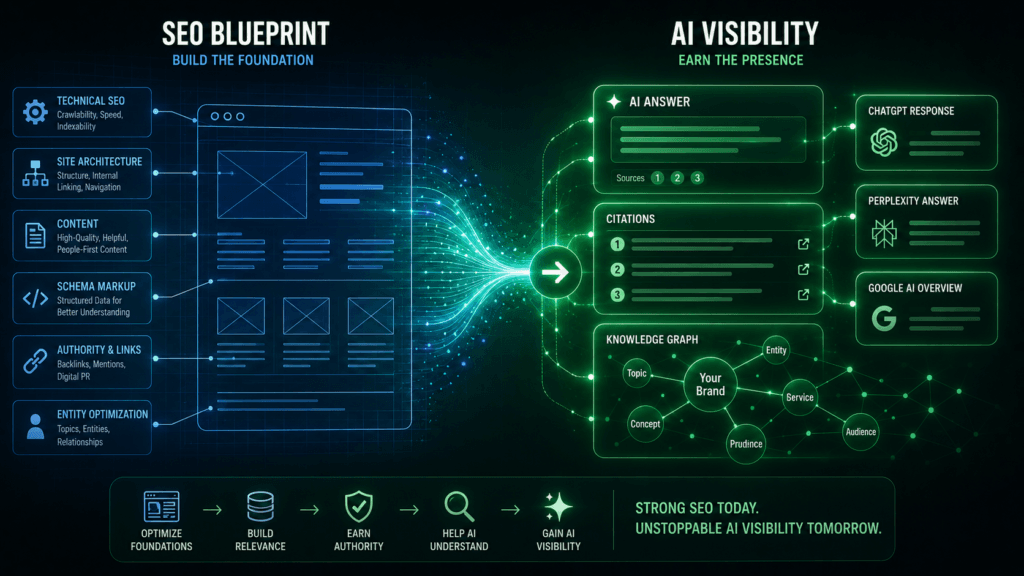
SEO isn’t dying. It’s becoming something more fundamental: the infrastructure layer that every GEO (Generative Engine Optimization) strategy runs on top of. Understanding why that’s the case and what it means for how brands should invest is one of the most important strategic questions for any marketing team navigating the shift to AI-powered search.
Why the “SEO Is Dead” Narrative Gets It Wrong
The narrative usually goes like this: AI Overviews and AI chat tools are replacing traditional search results, clicks are declining, and therefore investing in SEO is wasted effort. The logic sounds reasonable on the surface, but it misunderstands how AI search actually works.
Google confirmed this plainly in its May 2026 guidance: AI Overviews and AI Mode are not running on a separate index or a separate set of ranking signals. They are running on the same signals as traditional Google Search crawlability, indexing, content quality, authority, relevance. The content that appears in an AI Overview is almost always content that already ranks well in traditional search results. The pages Google selects to cite in a generative answer are the same pages Google trusts enough to rank highly in its non-AI results.
In other words: if your SEO is weak, your GEO has no foundation to stand on.
What “Infrastructure” Actually Means Here
When we describe SEO as infrastructure for GEO, we mean something specific. Infrastructure is the underlying system that everything else depends on it’s not visible when it’s working, but everything breaks without it. Roads are infrastructure for logistics. Servers are infrastructure for software. SEO is infrastructure for AI search visibility.
Here’s what that looks like in practice across the core SEO disciplines:
Technical SEO → AI Crawlability
If Googlebot can’t crawl and index your pages, Google’s AI systems cannot cite them in an AI Overview. There is no AI-specific backdoor into the index. Clean site structure, fast load times, no crawl blocks on important content, proper canonicalization these technical fundamentals directly determine whether your content is even eligible to appear in AI-generated answers.
Content Quality → AI Extractability
AI systems don’t just index content they extract specific pieces of it to construct synthesized answers. Content that is well-structured, factually clear, and organized around answerable questions is far more likely to be extracted accurately and cited than content that is vague, poorly formatted, or padded for length. Every content quality principle in traditional SEO depth, expertise, clarity, original insight translates directly into GEO performance.
Link Authority → AI Trust Signals
Backlinks remain a signal of authority, and that authority carries into AI features. Google’s AI systems are more likely to cite content from sites that already carry strong authority signals in traditional search. Building genuine editorial links isn’t just a traditional SEO tactic it’s building the trust infrastructure that AI systems rely on when deciding which sources are credible enough to cite.
Entity SEO → AI Brand Recognition
This is where traditional SEO evolves most noticeably in a GEO context. Entity SEO establishing your brand as a clearly defined, consistently described entity across the web is the mechanism by which AI systems learn to associate your brand with a specific topic, category, or expertise area. Without entity clarity, even a well-optimized site can be invisible to AI systems that aren’t sure what the brand actually is or what it stands for.
Where GEO Adds to the SEO Foundation
If SEO is the infrastructure, GEO is the layer built on top of it the additional work required to ensure that a technically sound, well-ranking site is also one that AI systems select, synthesize from, and cite.
The GEO vs SEO distinction isn’t that GEO replaces SEO’s priorities. It’s that GEO adds new considerations:
Content structure for extraction Beyond ranking for a keyword, content needs to be structured so that the specific answer to a question is easy for an AI system to locate and pull accurately. This means clear, direct answers near the top of sections, headings that map to specific questions, and well-organized supporting detail.
First-hand expertise signals AI systems, guided by Google’s quality evaluations, increasingly favor content that demonstrates genuine expertise through original insight, examples, and perspective not just accurate recitation of what’s already widely published. This pushes content quality requirements higher, not lower.
Topic comprehensiveness Ranking for a single keyword is less important than being recognized as a comprehensive source on a topic. AI systems are more likely to cite a site that covers a subject thoroughly across multiple angles than one that addresses a single narrow slice of it.
Brand consistency and credibility signals How ChatGPT, Gemini, and other AI tools recommend brands is partly shaped by how consistently and credibly a brand appears across independent, third-party sources not just its own website. Genuine mentions in credible publications and review contexts build the kind of distributed brand authority AI systems factor into recommendations.
The Strategic Implication: Don’t Split the Budget, Integrate the Strategy
One mistake brands make when they first encounter the SEO-vs-GEO conversation is treating them as competing budget lines “should we do SEO or GEO?” The infrastructure framing makes clear why that’s a false choice.
Investing in GEO while neglecting the SEO foundation produces a strategy with no ground to stand on optimizing for AI citation in a site that Google doesn’t trust or can’t crawl properly. Investing in traditional SEO while ignoring GEO considerations means building authority that doesn’t get fully leveraged in AI-generated answers, which is an increasingly large share of how people interact with search.
The right posture is integration: SEO and GEO executed together, where technical SEO, content quality, link authority, and entity signals are all treated as components of a unified AI search visibility strategy rather than separate disciplines with separate owners.
What This Means for 2026 and Beyond
The brands that will win in AI-powered search aren’t the ones that abandoned SEO for “new AI tactics” and they aren’t the ones that ignored the AI shift and kept doing exactly what they were doing in 2020. They’re the ones that recognized SEO is still the essential foundation, extended it with GEO considerations, and built strategies that work across both traditional rankings and AI-generated answers.
Answer Engine Optimization (AEO) structuring content to be recommended by AI systems answering direct questions is part of this same continuum. It’s not a replacement for SEO. It’s what SEO looks like when the destination for a query is an AI answer rather than a list of links.
The future of search isn’t SEO or GEO. It’s SEO as the infrastructure that makes GEO possible and brands that understand that are already ahead.
At Content Spring, we build search strategies that treat SEO and GEO as one integrated system starting with the technical and content foundations, then extending them to maximize visibility in AI Overviews, ChatGPT, Gemini, and every AI search surface your audience uses.
See How We Build AI Search Visibility →
FAQs
Is SEO still relevant in the age of AI search?
Yes. Google’s own guidance confirms that AI Overviews and AI Mode run on the same ranking and indexing signals as traditional Search. Pages cited in AI-generated answers are almost always pages that already rank well making strong SEO the prerequisite for any GEO strategy.
What is the difference between SEO and GEO?
SEO focuses on ranking web pages in traditional search results through technical optimization, content quality, and link authority. GEO (Generative Engine Optimization) extends those foundations to optimize specifically for how AI systems select, extract from, and cite content in AI-generated answers. GEO builds on top of SEO it doesn’t replace it.
Can you do GEO without SEO?
Not effectively. AI Overviews, AI Mode, and AI chat tools that use web retrieval rely on the same crawlability, indexing, and authority signals as traditional search. Content that isn’t indexed and trusted by Google has no path into AI-generated answers regardless of other optimization efforts.
What should brands prioritize SEO or GEO?
Both, treated as an integrated strategy rather than competing options. Technical SEO, content quality, and link authority form the infrastructure that GEO runs on. Adding GEO considerations content structure for extraction, entity clarity, topic comprehensiveness on top of a strong SEO foundation is the approach most likely to drive visibility across both traditional and AI-powered search.