
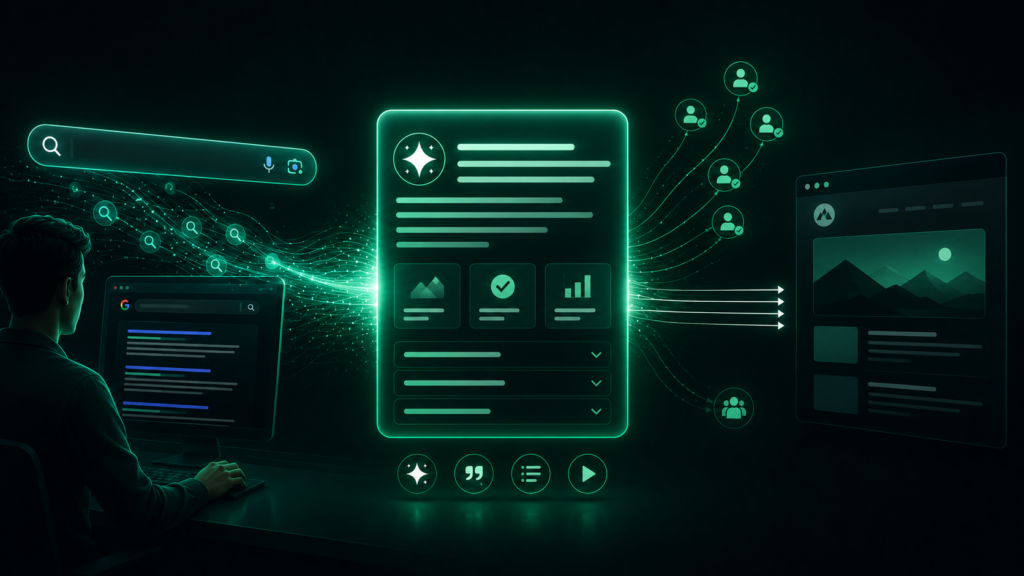
Search no longer guarantees a visit. A growing share of searches today end without a single click the user gets their answer directly on the results page and moves on. This is zero-click search, and it’s not a temporary trend. It’s becoming the default behavior for a large portion of search queries, driven primarily by AI Overviews, featured snippets, knowledge panels, and AI chat interfaces that answer questions before a user ever reaches a website.
For brands that built their entire growth strategy around organic click-through traffic, this shift is uncomfortable. But it’s not optional to ignore. Understanding why zero-click search is growing and adapting strategy around it is now a core part of staying visible in search.
What Is Zero-Click Search?
Zero-click search refers to any search query where the user’s need is fully satisfied on the search results page itself, without clicking through to a website. This happens through several mechanisms:
- AI Overviews Google’s AI-generated summary answers, synthesized from multiple sources, shown above traditional results
- Featured snippets direct text answers pulled from a page and displayed in a highlighted box
- Knowledge panels entity-based information boxes (for people, places, brands, organizations)
- Direct answers calculators, conversions, definitions, weather, sports scores
- AI chat interfaces ChatGPT, Gemini, and Perplexity answering questions conversationally, often without showing source links prominently
Each of these mechanisms has expanded significantly as search engines have integrated generative AI directly into the results experience.
Why Zero-Click Search Is Growing
AI Overviews Are Expanding Across More Query Types
What started as AI-generated answers for simple factual queries has expanded into more complex, multi-part questions, comparisons, and “best of” queries categories that previously required clicking through several websites to research. As AI Overviews cover more query types, the opportunities for zero-click resolution grow with them.
Users Have Adapted Their Behavior
Once users experience getting a complete answer without clicking, they begin to expect it. This creates a feedback loop: search engines design more zero-click experiences because users respond well to them, and users increasingly rely on instant answers because they’ve learned search engines provide them.
Mobile and Voice Search Favor Instant Answers
Mobile search and especially voice search through assistants is inherently biased toward single, direct answers rather than a list of links to browse. As mobile and voice usage grows, so does the share of queries resolved without a click.
AI Chat Tools Are Becoming a Search Substitute
A growing number of people now start their research in ChatGPT, Gemini, or Perplexity instead of Google. These tools often summarize information conversationally, citing sources only briefly or not at all another layer of zero-click behavior happening entirely outside traditional search engines.
What Zero-Click Search Means for Your Traffic
The practical impact is straightforward: even if your rankings stay strong, your click-through rate (CTR) can decline for the query types most affected by zero-click features primarily informational, definitional, and comparison-based searches.
This doesn’t mean your SEO is failing. It means the value of ranking well is shifting from “guaranteed traffic” to “guaranteed visibility” and visibility without a click still has worth, just not the kind that shows up in your Google Analytics sessions report.
What Brands Should Do About Zero-Click Search
1. Audit Which of Your Pages Are Most Exposed
Start in Google Search Console. Compare impressions and clicks for your top informational and top-of-funnel pages over the last 6-12 months. Pages with stable or rising impressions but falling clicks are the ones most affected by zero-click features. This tells you where to focus your strategy adjustments.
2. Shift Some KPIs from Clicks to Visibility and Citations
If a query is going to be answered via AI Overview or featured snippet regardless of what you do, the realistic goal becomes being the cited source, not winning the click. Track:
- How often your brand appears in AI Overviews (manually spot-check key queries)
- Featured snippet ownership for your priority keywords
- Brand mentions in AI chat tool responses (ChatGPT, Perplexity, Gemini)
3. Structure Content to Be the Answer, Not Just a Source
Pages most likely to be pulled into AI Overviews and featured snippets share common traits: a clear, direct answer near the top of the page, well-organized headings that map to specific sub-questions, and concise, factual language. Structuring your content this way increases your odds of being the source AI systems choose to cite.
4. Double Down on Queries Where Clicks Still Happen
Not every query is vulnerable to zero-click resolution. Transactional queries, local searches, pricing comparisons, and anything requiring nuanced judgment or real-time specificity are less likely to be fully answered by AI without a click-through. Prioritize content and SEO investment toward these query types where traffic capture is still realistic.
5. Build Demand Outside of Search
If a meaningful share of your audience’s search behavior is being absorbed by zero-click experiences, organic search traffic alone can’t be your only growth channel. Email, social, communities, and direct brand search (people searching your brand name directly) become more important as undiluted sources of traffic that aren’t subject to AI summarization.
6. Invest in GEO Alongside Traditional SEO
Generative Engine Optimization (GEO) optimizing specifically for how AI systems select, summarize, and cite content is the direct response to a zero-click world. Where traditional SEO optimizes for ranking position, GEO optimizes for being the source AI chooses to use, which matters more as more queries get fully resolved without a click.
The Bottom Line
Zero-click search isn’t a glitch or a temporary side effect of AI experimentation it’s the direction search is permanently heading. Brands that treat every ranking as a guaranteed visit will increasingly find their traffic numbers don’t match their ranking reports. The brands that adapt are the ones reframing success around visibility, citation, and brand recall not just clicks while still defending the query types where traffic capture remains realistic.
At Content Spring, we help brands build search strategies that account for this shift combining traditional SEO with GEO and AEO so you’re not just ranking, but actually showing up wherever your audience is asking questions, click or no click.
Get a Free AI Search Visibility Audit →
Related Reading
- The Great Decoupling: Why Rankings Are Up but Traffic Is Down
- Google AI Mode vs AI Overviews
- What Is GEO (Generative Engine Optimization)
- How to Track AI Search Visibility KPIs in 2026
FAQ (for Featured Snippets / AI Overviews)
What is zero-click search?
Zero-click search happens when a user’s query is fully answered directly on the search results page through AI Overviews, featured snippets, or knowledge panels without the user clicking through to a website.
Why is zero-click search increasing?
Zero-click search is growing because AI Overviews now cover more query types, mobile and voice search favor instant answers, and AI chat tools like ChatGPT and Gemini increasingly resolve queries conversationally without requiring a website visit.
Does zero-click search mean SEO is becoming useless?
No. SEO is shifting in focus rather than becoming obsolete. Ranking well still matters for visibility and citation in AI-generated answers, even when it doesn’t always result in a click. Transactional and local queries also remain largely unaffected.
How can brands measure zero-click impact?
Compare impressions versus clicks in Google Search Console over time. A growing gap stable or rising impressions alongside declining clicks indicates zero-click features are absorbing traffic for those queries.